Monday, November 16, 2009


This graphic clearly illustrates the disparity between men and women in the media. Considering the fact that women watch more television than men and women make up 46% of the work force, these are definitely sobering statistics. So why is there such a large difference in the diversity of the media? Suprisingly, new research on twitter use may offer some light on the subject. After looking at research on social networking and who uses these sites most, the numbers show that women hold a good advantage over men, but who women follow on twitter was somewhat suprising. Here is a link to the original article, from Harvard.
http://blogs.harvardbusiness.org/cs/2009/06/new_twitter_research_men_follo.html
Does this suggest, however, that the trend of media usage is to prefer male sources? Or is this just another anomaly among media producers who are mostly male?
-James Rutherford
The gender roles projected through various media outlets are subtle. They are neither completely overt nor entirely subliminal. The lens of education helps to clarify what exactly it is the consumers of media are being told. Men are nearly always conveyed as strong an in control. Women are nearly always beautiful compliments to their strong man. In sports they are given the shortest airtime possible while their male counterparts nonchalantly relax and make informative conversation about the sport at a hand. In cartoons they are often times reduced to an air-headed object to be rescued. Velma is often times the smartest person in the gang but she is unattractive and nerdy, not a strong intelligent woman to be desired. These are the stories of what is to be a man or woman in America. These are the myths of gender. This is the haze that needs to be dispersed through education and increased analysis of the messages we allow ourselves to consume.
-Scott
-Scott
Saturday, November 14, 2009
Women in ads targeted towards men


 The woman’s role in beer and cigarette ads is to be a trophy, props for male characters. In these ads women are often in groups surrounding one man, a common established stereotype of the roles of males and females in society. In men's magazines, women bodies are usually the focal point and women usually play the stereotypical role of a seductress. By playing the role of a seductress in various men's magazines, women are naturally seen as sex objects.

-Stephanie S.
Men in ads targeted towards men
Popular Men's magazine


-Stephanie S.


In print advertisements, the roles of men and women are usually offensive as they are often stereotypical. The contents of various men’s magazine are “reviews of films, music, video games and books…Loaded [magazine] celebrates watching football with a few beers for example, but the Men’s Health reader would forego the drinks, and play the game himself. FHM encourages quality of sex, whilst Front stands for quantity” (Gauntlett, 2002). When men appear in ads they are generally seen as active, providers and macho. In men's magazines, men are usually engaging in physical activities and are usually associated with strength and power. The physical roles that men play in ads are often various types of athletes (tennis, football, baseball players) engaging in sport or as a ladies' man in a club.


-Stephanie S.
The dominate women in the media
Let's not discriminate by saying there are no women that are aggressive in today's media because lets face it, we have a lot of female heroes and apprentices but although these powerful women do hold a face in today's media as either the hero or the sidekick, can any woman be a hero?
Megan Fox
Transformers 2


Angelina Jolie
Tomb Raider


Drew Barrymore, Cameron Diaz, Lucy Liu
Charlie's Angels


If today's female heroes have to look like these women,
Lets leave it to the professionals.
~Nyomi Jackson
Megan Fox
Transformers 2

Angelina Jolie
Tomb Raider


Drew Barrymore, Cameron Diaz, Lucy Liu
Charlie's Angels


If today's female heroes have to look like these women,
Lets leave it to the professionals.
~Nyomi Jackson
Muscles and Mystique

Is this what it is to be Man?
The media is instrumental in defining concepts of Masculinity and Femininity.

Vision Test:Do you see the strong woman, with a degree from Harvard, making an expression of her sexuality. Or do you see another conquest to be had.
-Scott
When considering the effects of news media on gender roles, one only needs to look at the coverage of sports to see that the legendary singer James Brown was correct in saying “this is a man’s world”. ESPN, the aptly-described “world-wide leader in sports” boasts a total of 79 columnists on its website, espn.com, only eight of whom are female. That is almost ten males for every one female reporter. Of course, this seems fitting, because a recent visit to that website featured the images of more than a dozen athletes on the homepage, who are all male, and who better to tell the tale of male athletes than men? In fact, the only sports being covered regularly by the largest networks (FOX, CBS, NBC and ABC) come from only the largest sport leagues (the NFL, NBA, MLB, NHL and PGA), none of which allows female participants.

In the interest of fairness, however, there is a female presence heard and seen during major-league televised sporting events. While watching a televised Jacksonville Jaguars football game, the fans of said team glare at the projected images of monstrous men plowing into and through each other, laugh along with the humorous commentary and jovial banter of former athletes who now provide background fodder for the event, and listen intensely to the decisions of the judicious zebra-striped referees. Occasionally, there is a close-up view plastered onto the screen of The Roar, Jacksonville’s scantily-clad cheerleader group, high-kicking for the boys in teal. And sometimes the commentators in the studio speak shortly with a female field reporter who brings a two-second summation of the coach’s frustration with how the game is going for his team, a report that is cut short because it’s time for a commercial.
Could it be that most women aren’t that interested in sports, so this multi-billion dollar industry has been generously given to the men of the world, including the coverage of sports, which is also a multi-billion dollar industry? Not likely. According to the NFHS 2003-2004 High School Athletics Participation Survey, female athletes comprised 41.5% of high school athletes. So maybe women just don’t watch that much TV, right? Nope. Neilson viewing statistics from 2007 show that men, 18+, watch TV four hours 55 minutes a day on average, and women spend five hours 43 minutes on average, almost one hour more than men.
Although the cause for this disparity within sports and sports media may be unknown, or due to many factors (inequality at executive level of media, sports industry, waning effects of generations of inequality within all industries, etc.), the proprietors of sports and the media that cover them had better change their tune to survive. Most college students are now female, and women make 80% of all buying decisions in all homes. With more households being headed by women, more women graduating college and earning more pay, and more female participation in sports programs, the archaic ways of the world of sports are soon to change as well. If the ones who rule the game don’t see these realities for what they are soon, they may find themselves on the sidelines, off the field, and out of the studio.
-James Rutherford

In the interest of fairness, however, there is a female presence heard and seen during major-league televised sporting events. While watching a televised Jacksonville Jaguars football game, the fans of said team glare at the projected images of monstrous men plowing into and through each other, laugh along with the humorous commentary and jovial banter of former athletes who now provide background fodder for the event, and listen intensely to the decisions of the judicious zebra-striped referees. Occasionally, there is a close-up view plastered onto the screen of The Roar, Jacksonville’s scantily-clad cheerleader group, high-kicking for the boys in teal. And sometimes the commentators in the studio speak shortly with a female field reporter who brings a two-second summation of the coach’s frustration with how the game is going for his team, a report that is cut short because it’s time for a commercial.
Could it be that most women aren’t that interested in sports, so this multi-billion dollar industry has been generously given to the men of the world, including the coverage of sports, which is also a multi-billion dollar industry? Not likely. According to the NFHS 2003-2004 High School Athletics Participation Survey, female athletes comprised 41.5% of high school athletes. So maybe women just don’t watch that much TV, right? Nope. Neilson viewing statistics from 2007 show that men, 18+, watch TV four hours 55 minutes a day on average, and women spend five hours 43 minutes on average, almost one hour more than men.
Although the cause for this disparity within sports and sports media may be unknown, or due to many factors (inequality at executive level of media, sports industry, waning effects of generations of inequality within all industries, etc.), the proprietors of sports and the media that cover them had better change their tune to survive. Most college students are now female, and women make 80% of all buying decisions in all homes. With more households being headed by women, more women graduating college and earning more pay, and more female participation in sports programs, the archaic ways of the world of sports are soon to change as well. If the ones who rule the game don’t see these realities for what they are soon, they may find themselves on the sidelines, off the field, and out of the studio.
-James Rutherford
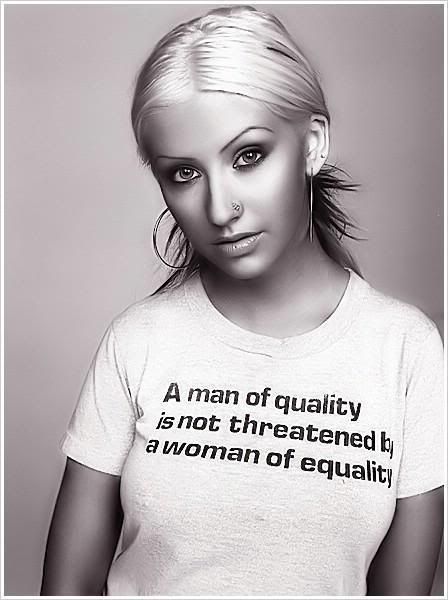


When women are discriminated against for not keeping a feminine profile,do we then blame the media?
After hearing Don Imus's comment about the women's basketball game, most people were heavily offended by what he said calling his comment racist and misogynistic and although what Imus said was very hurtful, where was the line drawn before that? When did we as a nation say " you can say this,this and that, but you had better not say that!" Women are the most demeaned gender group in society and although Don Imus's offensive comment had to be the display to bring more attention to how we characterize and treat women, we still see and hear the most demeaning things about women today.
~Nyomi Jackson
After hearing Don Imus's comment about the women's basketball game, most people were heavily offended by what he said calling his comment racist and misogynistic and although what Imus said was very hurtful, where was the line drawn before that? When did we as a nation say " you can say this,this and that, but you had better not say that!" Women are the most demeaned gender group in society and although Don Imus's offensive comment had to be the display to bring more attention to how we characterize and treat women, we still see and hear the most demeaning things about women today.
~Nyomi Jackson
Most people, when asked "who are you", would respond by giving descriptions of what they do, where they work, perhaps what sign they were born under, maybe even claim their family name. But how often do we define ourselves by what we are not? We probably do this more than we realize. After recently reading Mark Twain's Huckleberry Finn I was struck by how Finn's true identity is discovered when he tries to assume the role of a girl. After entering the home of a woman he does not know and introducing himself as "Sarah Williams from Hookerville" he believes he is doing well in his disguise, but the woman is suspicious. She claims to see a rat and tosses a chunk of lead to Finn, who clasps his legs together, catches the chunk and then throws it very well at the rat. The woman tells him she knows his secret because he neither catches nor throws like a girl.
This suggests very plainly that, although his abilities define Huckleberry Finn, so do his inabilities. If he can throw well, he must be a boy, and he would have to throw poorly to be a girl. This simply puts forth the concept of nurture vs. nature, suggesting that the genetic makeup of a person, whether it be XX or XY, must also be a performance.
When looking at the way media, in all it's forms, defines gender, we can see that much of it is a performance. We preform our roles subconciously in our daily lives, but what we see, read and hear is done with much purpose. The roles of men are played out by actors choosing to portray the very ideal image of a man, defined not only by what a typical man is but just as importantly what he is not. The same goes for women, and we as consumers reflect these stereotypical depictions to the most minute detail.
This is not to suggest that we not perform our roles so much as it is a warning that perhaps choosing not to learn certain usefull abilities because those abilities do not fit our gender role is a foolish notion. We should never sell ourselves short and define ourselves by what we are not. Instead, we should allow ourselves to be defined by all that we are, can and should be.
-James Rutherford
This suggests very plainly that, although his abilities define Huckleberry Finn, so do his inabilities. If he can throw well, he must be a boy, and he would have to throw poorly to be a girl. This simply puts forth the concept of nurture vs. nature, suggesting that the genetic makeup of a person, whether it be XX or XY, must also be a performance.
When looking at the way media, in all it's forms, defines gender, we can see that much of it is a performance. We preform our roles subconciously in our daily lives, but what we see, read and hear is done with much purpose. The roles of men are played out by actors choosing to portray the very ideal image of a man, defined not only by what a typical man is but just as importantly what he is not. The same goes for women, and we as consumers reflect these stereotypical depictions to the most minute detail.
This is not to suggest that we not perform our roles so much as it is a warning that perhaps choosing not to learn certain usefull abilities because those abilities do not fit our gender role is a foolish notion. We should never sell ourselves short and define ourselves by what we are not. Instead, we should allow ourselves to be defined by all that we are, can and should be.
-James Rutherford
The affect on children
It is more likely to see the stereo-types that are put into children’s programming when one is not so accustomed to gender stereo-typing in the first place, but since adults have been “brain washed” by adult programs where stereo typical gender roles are evident but none the less disregarded, it becomes unimportant to the parent to make sure their child isn’t under the media’s influence. In educational programs for children men seem to be the leading characters in often instances, while women may play the apprentice but in instances where a woman may hold some power in an occupational area, her job is mostly in the field of caring, nurturing and not showing much aggression if any (Ingham 1997). Women even in children’s programming are seen in the stereo typical light of being “care takers and in often times, letting the more masculine figure dominate the show.
~Nyomi Jackson

When considering something as simple as children’s programming, it may not be as easy to see hidden messages as it may when involving adult programming. We may overlook things such as gender roles. Consider the popular television show “Scooby Doo”, created in 1969 for smaller children. This television program still runs even today but some may overlook the subliminal messages and gender roles that can be interpreted from this simple television show. In the show there are five teenagers who call themselves Mystery Inc. and each show portrays different scenarios that they encounter while uncovering new mysteries. What is not a mystery is the archatypes and gender roles that are embodied in the role that each character plays.
The characters names in the show are familiarly known as Daphne, Freddy, Shaggy, Velma and Scooby Doo and although the roles that they play in each episode are constant the dynamics of the female gender in the show is very obscured. Velma is the brainiac and always seems to come up with in genius ideas that in the long run always conclude to figuring out the mystery. Although Velma is quite intelligent she is also unattractive, from her short dull haircut to her bulky glasses the stereotype of smart young women is played out by unattractive Velma. While on the other hand Daphne who always seems to fall into the trap of the villain and ultimately need rescuing is a tall attractive redhead with curves. This is a simple example of the kinds of messages that children are bombarded with everyday in simple program television.
~Nyomi Jackson
Friday, November 13, 2009
Double Standards
There are many examples of bias when it comes to images of the human body in the media, but two recent events seem to stand out among the rest as the pinnacle of double standards regarding the subject. I'm talking about Miley Cyrus vs. Taylor Lautner.
You might remember the scandal ensuing Miley Cyrus' "racy" photo spreads in a 2008 issue of Vanity Fair. The entertainer, then 15, was criticized on almost every talk show for a month, and calls for her employer, Disney, to pull the plug on her were coming from every corner of the nation. Fast forward a year to the premier of "The Twilight Saga: New Moon" with a shirtless picture of Taylor Lautner helping sell the saga to millions of fans and a new question arises: If both entertainers are minors, why not the same outcry? There is a double standard in the media and this is only the tip of the iceberg.
Think about Ray-J and Kim Kardashian and the results of their sex-tape scandal. Both come out in the end with a television show, and the creation of said tape may very well have been a ploy by the two to increase their market value, but the results speak volumes to the double standard. The talking heads on t.v. label her a tramp, and as for Ray-J? Well, boys will be boys.
As a new generation comes of age in an era of social networking websites and technology that places a video camera the size of a candy bar in the pockets of almost every boy and girl, the double standards that relate to images of the body increase the divide between what is acceptable based on gender. Will this new generation let themselves be defined by what their facebook profile image says they are, or will they let their true selves define their image?
-James Rutherford
You might remember the scandal ensuing Miley Cyrus' "racy" photo spreads in a 2008 issue of Vanity Fair. The entertainer, then 15, was criticized on almost every talk show for a month, and calls for her employer, Disney, to pull the plug on her were coming from every corner of the nation. Fast forward a year to the premier of "The Twilight Saga: New Moon" with a shirtless picture of Taylor Lautner helping sell the saga to millions of fans and a new question arises: If both entertainers are minors, why not the same outcry? There is a double standard in the media and this is only the tip of the iceberg.
Think about Ray-J and Kim Kardashian and the results of their sex-tape scandal. Both come out in the end with a television show, and the creation of said tape may very well have been a ploy by the two to increase their market value, but the results speak volumes to the double standard. The talking heads on t.v. label her a tramp, and as for Ray-J? Well, boys will be boys.
As a new generation comes of age in an era of social networking websites and technology that places a video camera the size of a candy bar in the pockets of almost every boy and girl, the double standards that relate to images of the body increase the divide between what is acceptable based on gender. Will this new generation let themselves be defined by what their facebook profile image says they are, or will they let their true selves define their image?
-James Rutherford
Subscribe to:
Posts (Atom)

